Maximising Narrow Spaces with Plants


Plants that have an upright growth like Ginkgo biloba fastigiata and Lomandra Lime Tuff (left) and Cupressus sempervirens Totem and Coprosma virescens (right) are great for narrow gardens.
Maximising Narrow Spaces with Plants
In the realm of gardening and landscaping, narrow spaces often present a unique challenge. However, with the right selection and arrangement of plants, even the most constrained areas can be transformed into captivating green havens. Utilising plants in narrow spaces comes down to focusing on two key principles: repetition and strong textural difference. By embracing these concepts, you can create visually striking compositions that maximise the potential of limited areas.
Repetition is the key to success. By keeping the plant varieties to a minimum and focusing on multiples, you can achieve impactful results. The secret lies in combining strong textural differences and utilising a combination of tall and narrow trees, rounded shrubs, and contrasting spiky textures.
Completely Green Look
For an all-green aesthetic, consider combining Cupressus sempervirens Stricta, Pittosporum Pom Pom, and Lomandra Lime Tuff. The tall and narrow silhouette of Cupressus sempervirens Stricta provides a vertical element, while the rounded shape of Pittosporum Pom Pom adds depth. Lomandra Lime Tuff, with its textural appeal, completes the ensemble, creating a visually pleasing and low-maintenance green paradise.

Using plants that are the same colour but have different textures and shapes is a great way to add interest while creating unity.
Espaliered Beauty
For a more structured and rhythmic approach, espaliering trees like this Fig along wires on a wall is another great way to enhance a narrow garden. To enhance the design, we placed Phormium Emerald Gem and Muehlenbeckia axillaris beneath the espalier to provide a contrast in texture and colour. This arrangement provides an artistic and well-balanced display, as the autumnal red leaves of the Fig complement the impressive green swords of the flax.
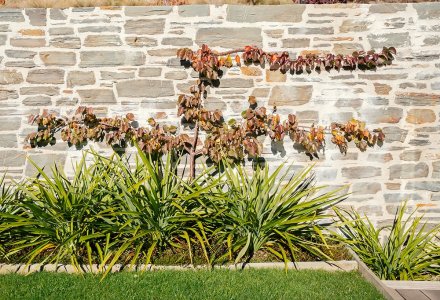
Espalier is a popular technique for growing trees, especially fruit trees, in a limited space.
Pleaching for Privacy
If your narrow side garden feels exposed to neighbouring homes, consider pleaching Prunus lusitanica (Portuguese laurel). This living screen softens the space and is much more appealing than a hard fence. At ground level, a low hedge of Corokia Geentys Green is maintained at 500mm high, adding a crisp finish to the overall planting and suppressing weed growth.

Pleaching is better for narrow gardens when compared to hedges as it leaves space underneath for more plants to be grown.
Masonry Wall Cover-Up
To quickly cover a masonry wall in a shady restricted space, choose Parthenocissus quinquefolia (Virginia Creeper). To stretch its summer greenery from wall to floor and make the garden appear larger, we added Pachysandra terminalis as a ground cover - a great way to brighten up the dark corners of the garden and suppress weeds at the same time.

If you're not sure what to do with an ugly wall or fence on your property, finding a great climber like this Virginia Creeper to grow over it is a good solution.
Sculptural Drama
In a narrow space, Pseudopanax ferox (Lancewood) is an ideal plant choice due to its tall and sculptural form. It effectively filters unwanted views while showcasing dramatic textural foliage which makes it particularly suited for contemporary architecture. To add a touch of informality at ground level, consider introducing loose-textured plants like one of the NZ Iris family, such as Dietes grandiflora or Arthropodium Matapouri Bay. In this garden, we planted the dainty yet hardy Gaura Sparkle White amongst the Lancewood to break up the lines and brighten the space.

Our native and ancient Lancewoods are a great option for those after a more contemporary look in a tight space.
By employing these thoughtful plant pairings, you can transform your narrow spaces into stunning outdoor havens. Remember to choose plants that suit your specific environmental conditions and create a cohesive design by repeating key elements. Don’t let a small space stop you from enjoying a great garden!
RELATED PRODUCTS
 Notify Me