Nature Designs Simply: Plant Your Garden in Three Layers
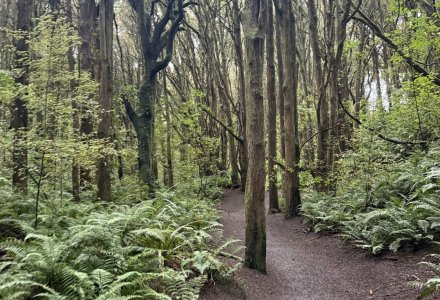
Next time you are standing in a patch of native bush, stop and look at what is actually growing around you. There is not much variety. The same few plants, over and over.
That is why bush feels calm to stand in. It is also the most useful thing you can copy at home.
What makes native bush feel calm?
Bush feels calm because it is built from three layers and a short plant list. A canopy overhead, a mid layer beneath it, and an understorey at ground level. The same handful of species repeat through the whole space, so your eye reads a pattern rather than a collection.
Look at the photo above. Tall trunks holding the canopy, small trees through the middle, ferns covering the ground. Six or seven species in the whole scene.
Most home gardens do the opposite. One of everything, bought over several seasons, each plant on its own. Nothing is wrong with any single plant, but the space never settles. Variety is the problem, not the cure.
The five things that make three-layer planting work
- Three clear layers. Structure overhead, a mid layer at eye level, an understorey at your feet. Each layer has a job and none of them competes.
- A short plant list. Five or six species across the whole planting is plenty. Ten is usually too many.
- Repetition. Use the same plants again and again along the bed. Repetition is what creates flow.
- Groups, not singles. Plant in threes and fives. A single plant reads as an object. A group of five reads as planting.
- Overlap between layers. The mid layer runs under the canopy, the understorey under the mid layer. Layers should sit into each other, not line up in rows.
Nature is big. Your section is not.
The principle scales down without changing. You are not planting a forest, you are borrowing its proportions.
As a rule of thumb, the canopy sits at roughly twice the height of the mid layer, and the mid layer at twice the understorey. In bush that might be 15 m, 6 m and 1 m. On a suburban section, 5 m, 2 m and 0.5 m. In a courtyard, a 3 m tree, a 1 m shrub and a 300 mm groundcover still reads the same way.
All three layers need to be present. A garden with only a mid layer looks flat. One with only trees and lawn looks empty underneath.
The same three layers, in four very different gardens
The layers describe structure, not species. That is why this works whatever style you are after. Here is the same idea in four gardens that look nothing like each other.
Native
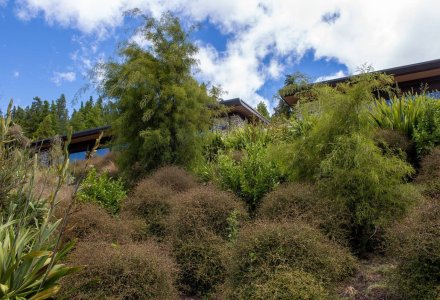
Small trees above, mounded shrubs through the middle, flax and tussock grasses holding the bank at ground level. The plant list is short and the same shapes repeat across the slope. That repetition is the difference between a native garden and a patch of scrub.
Contemporary
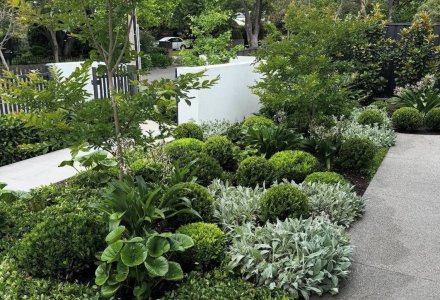
Clipped shapes carry the mid layer here, with small trees over the top and a run of silver and green foliage below. Nothing here is rare. Repetition is doing all the work, and the restraint is what makes it calm.
Formal and structured
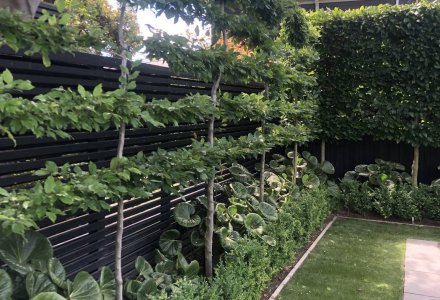
Pleached trees hold the canopy at a fixed height, a clipped hedge and low border make the mid layer, and large round leaves cover the ground. Three layers, a handful of species, repeated the length of the boundary.
Cottage
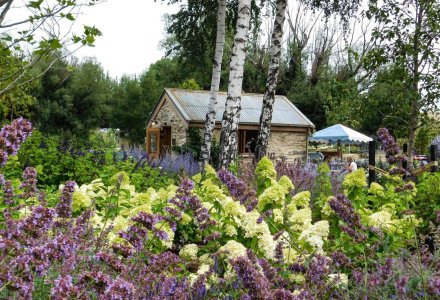
Birch trunks above, hydrangea through the middle, salvia and catmint at ground level. Cottage planting looks loose, but the bones are identical. The looseness sits in the understorey, not in the structure.
A ( native ) plant palette to start with
The list below is a native starting point. Pick one or two from each layer, plant plenty of each, and resist adding more names.
Structure: the canopy layer
- Kōwhai (Sophora microphylla). Around 6 to 8 m. An open canopy that lets light down to the layers below, with yellow flowers in early spring and tūī with them.
- Lancewood (Pseudopanax crassifolius). Around 4 to 6 m and very narrow. Use it where you want height but have no width.
- Ribbonwood (Plagianthus regius). Around 8 to 10 m and fast. Deciduous, so it lets winter light back into the garden. Happy on damper ground.
Mid layer: the connector
- Kōhūhū (Pittosporum tenuifolium). The straight species, not a dwarf cultivar. Reaches 4 to 6 m if left, or hold it at 2 m with a yearly trim. Fast, and the plant that fills this layer quickest.
- Horopito (Pseudowintera colorata). Around 1.5 to 2 m and slow. Red-mottled foliage that lifts a shaded bed. Wants shelter and soil that does not dry out.
- Pseudopanax lessonii 'Purpureus'. Around 2 to 3 m. Dark bronze-purple foliage that gives the mid layer contrast without adding another shape.
Understorey: the ground
- Chionochloa flavicans. Around 1 m by 1.2 m. An arching tussock with tall flower heads. Sun to part shade, free-draining soil.
- Carex testacea. Around 0.5 m. For the sunny, drier edge, in drifts rather than dots.
- Crown fern (Blechnum discolor). Around 0.6 to 1 m. For the shaded, damper side where little else settles.
All nine suit gardens from Northland to Southland. From Taupō south, shelter young lancewood and horopito from hard frost. Pittosporum takes the cold better than most.
How many plants do you actually need?
Work in blocks of 3 metres. Count how many fit along your bed, then multiply.
- Full and tidy. 1 tree, 5 shrubs and 13 groundcover plants per 3 metres, so a shrub every 600 mm and a groundcover plant every 450 mm. Fills in 2 to 3 years.
- Standard. 1 tree, 3 shrubs and 9 groundcover plants per 3 metres, so a shrub every metre and a groundcover plant every 600 mm. Fills in about 3 years.
- Loose and natural. 1 tree every 6 metres, 2 shrubs and 6 groundcover plants per 3 metres, so a shrub every 1.5 m and a groundcover plant every 800 mm. Fills in 4 to 5 years.
A 9 metre bed at standard spacing is 3 trees, 9 shrubs and 27 groundcover plants. Results vary by region, site exposure, soil, and starting grade.
Then set them out like this. Trees go towards the back, evenly spaced. Shrubs sit in front of and between them in groups of three, not in a straight line. Groundcover fills everything else, running forward to the edge and back into the gaps. Aim to see each species at least three times along the bed.
Adjust for your site:
- Coastal. Pittosporum and Carex handle salt wind. Give horopito a sheltered corner.
- Windy. Use the full and tidy spacing so plants shelter each other while they establish.
- Frost-prone. Lead with kōwhai, ribbonwood, Pittosporum and Carex.
- Damp or heavy soil. Ribbonwood, horopito and crown fern cope. Chionochloa and Carex want free-draining soil, so mound their positions.
Swaps: if Chionochloa is unavailable, use Astelia at the same spacing. If ribbonwood is too big for your site, use a second kōwhai or a lancewood instead.
First 12 weeks: water deeply twice a week for the first month, then weekly through the first summer. Mulch to 75 mm, kept clear of stems. Hold off feeding until new growth appears, and do not prune beyond removing damage.
Why layered planting is easier to look after
Fewer species means fewer jobs. Six plants across a border means one pruning approach and one feeding routine, not fifteen different sets of care instructions to remember.
The layers also do maintenance work for you. Groundcover shades the soil, holds moisture and closes the gaps where weeds start. The canopy filters wind and hard sun, which takes the stress off everything underneath. Once the layers knit together, weeding drops away because there is nowhere for weeds to get established.
Replacing plants is simpler too. When you lose one, you already know what goes back in, because there are five more of it in the bed. Ordering is easier for the same reason. Ten of one plant is cheaper than ten different ones, and arrives as one consistent batch from the nursery.
If something goes wrong
If your plants arrive damaged or not as expected, get in touch within 48 hours with a photo and your order number. We'll sort it. For ongoing growing questions, our team is happy to help.
Where to start
- See how three-layer planting looks in real gardens in our Plant Locator Gallery, then find the plants in each photo.
- Get a plan drawn for your site with our remote garden design service, including quantities and spacing.
- Build the palette yourself from our NZ natives, shrubs, specimen trees and grasses and strappy plants.
FAQs
How many different plants should I use in one garden bed?
Five or six species is enough for most suburban beds, planted in repeating groups. Use one or two for the canopy, two for the mid layer and two for the understorey. If a bed feels busy, the fix is almost always fewer species and more of each.
Can I use three-layer planting in a small courtyard?
Yes, and it works particularly well in small spaces. Scale each layer down: a 3 m tree, a 1 m shrub repeated three or four times, and one groundcover running underneath. The proportions matter more than the sizes.
Do the three layers have to be native plants?
No. The three layers describe structure, not species, so the same approach works with a formal palette, a contemporary one or a cottage garden. Native bush is simply the clearest place to see the principle at work.
Which layer should I plant first?
Plant the canopy first, because it sets the position of everything else and takes longest to make an impact. Add the mid layer next, then finish with the understorey once you can see where the shade and gaps fall. Splitting the work across two seasons is fine.
How long before it looks like a finished garden?
Expect about three years at standard spacing, and two at closer spacing. The mid layer fills first, the understorey closes over in the second summer, and the canopy takes longest. Planting a larger grade at the start buys you roughly a season.
RELATED PRODUCTS
 Notify Me