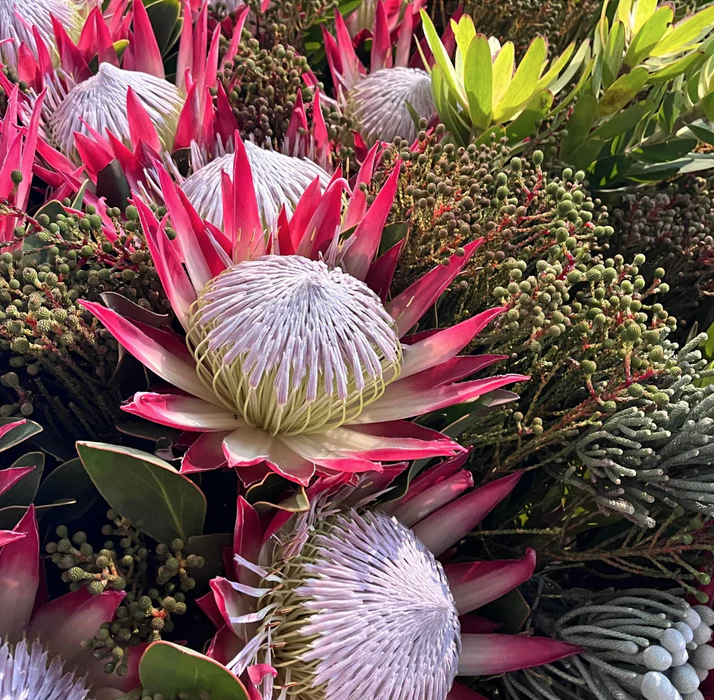
Protea cynaroides
Protea cynaroides, the King Protea, is an evergreen shrub grown for its large flower heads with deep crimson bracts surrounding a cream-coloured centre. Each bloom can reach 20 to 30cm across, making it one of the most architecturally striking flowers in any garden. This protea also makes an excellent cut flower that holds well in a vase. Plants grow to around 1 to 2m high and wide over time.
The King Protea suits a coastal garden, a dry sunny border, or a low-water modern planting. Use it as a feature shrub where the flowers can be seen up close. Pair it with other proteas, leucadendrons, and ornamental grasses for a textured, water-wise bed that rewards minimal maintenance.
Grow this protea in full sun with free-draining soil. It needs low-phosphorus, slightly acidic ground and dislikes rich or heavily amended soil. Sandy or gravelly banks suit it well. Good airflow and sharp drainage are the keys to a healthy, long-lived plant.
This protea is frost-tender and is not suited to frost-prone inland areas such as Central Otago or inland Southland without shelter. Proteas are not listed as toxic to pets, but as with any garden plant, discourage pets from chewing the foliage.
Trimming: Prune after flowering to maintain a compact shape. Cutting blooms for the vase doubles as pruning. Avoid cutting back into old bare wood, as proteas are slow to reshoot from it.
Deadheading: Deadheading is not essential. Removing spent flower heads tidies the plant and can encourage new growth, but leaving them does no harm.
Fertilising: Do not use standard fertiliser. Proteas are sensitive to phosphorus and can decline quickly if overfed. If feeding at all, use a low-phosphorus protea-specific feed in spring, applied sparingly.
Watering: Water regularly through the first year to help the plant establish. Once settled, water only during long dry spells. Established plants are drought-tolerant and dislike constant moisture around the roots.
Pest Control: Proteas are largely trouble-free. On stressed plants, watch for scale and mealybugs. Treat early with horticultural oil before populations build.
Disease Management: Sharp drainage is the main defence against decline. Wet, heavy, or phosphorus-rich soil invites Phytophthora root rot, which is the most common cause of protea failure. Keep the root zone open, airy, and free-draining.
Enjoy complimentary delivery anywhere in mainland New Zealand when you purchase plants worth $250 or more*.
For orders below $250, the following flat-rate delivery charges are applicable:
- Urban delivery within mainland New Zealand: $19.95
- Rural delivery within mainland New Zealand: $39.95
- Waiheke, Chatham and Great Barrier Islands: Please contact us for shipping options.
We aim to have all orders shipped within 14 days from the order date, unless a different shipping date is specified alongside a product.