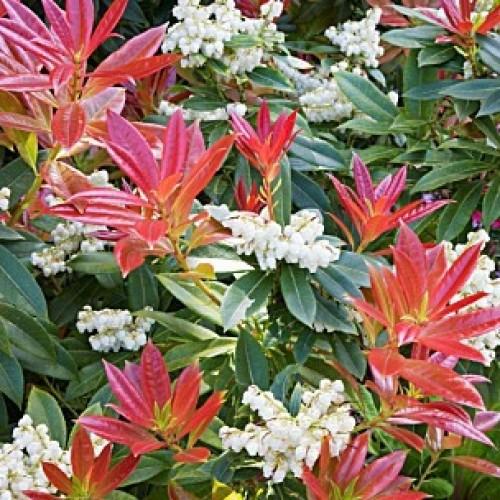
Pieris Wakehurst
Pieris Wakehurst is a compact evergreen shrub valued for its glossy green foliage, attractive form, and clusters of delicate white flowers that appear from late Winter into Spring. Fresh new growth emerges in rich bronze to red tones, adding seasonal colour and contrast before maturing to deep green.
It is well suited to woodland-style planting, shaded borders, courtyard gardens, and mixed shrub plantings. Pieris Wakehurst also makes an excellent feature in containers or as part of an acid-loving planting scheme with camellias, azaleas, and rhododendrons.
This plant grows best in part shade with shelter from harsh afternoon sun and strong winds. It prefers moist, well-drained, humus-rich soil with an acidic character and should not be allowed to dry out completely. Space plants around 1m to 1.5m apart to give them room to develop a dense, balanced shape.
At maturity, it forms a neat, rounded shrub reaching around 2m high and 1.5m wide.
Trimming: Pieris Wakehurst needs very little routine pruning. Lightly trim after flowering to maintain a compact shape and remove any dead, damaged or wayward growth. Avoid hard pruning into old wood unless reshaping is necessary.
Deadheading: Remove spent flower clusters once flowering has finished to keep the plant tidy and help direct energy into fresh growth. Snip off the faded trusses carefully without damaging the new buds forming beneath them.
Fertilising: Feed in spring with a fertiliser suitable for acid-loving plants. A mulch of composted bark or leaf mould can also help maintain soil conditions and support healthy growth.
Watering: Water regularly during the establishment phase to keep the soil evenly moist. Once established, water during extended dry periods, especially in warm weather, as Pieris prefers consistently moist but well-drained soil.
Pest control: Watch for lacebug, aphids and vine weevil, particularly on stressed plants. Check leaves for stippling, distortion or poor growth, and treat with an appropriate insecticide or biological control where needed.
Disease management: Pieris can be affected by leaf spot and root rot, especially in poorly drained soil. Look for discoloured or spotted leaves, wilting, or dieback. Remove affected growth, improve drainage, and use a suitable fungicide if fungal problems persist.
Enjoy complimentary delivery anywhere in mainland New Zealand when you purchase plants worth $250 or more*.
For orders below $250, the following flat-rate delivery charges are applicable:
- Urban delivery within mainland New Zealand: $19.95
- Rural delivery within mainland New Zealand: $39.95
- Waiheke, Chatham and Great Barrier Islands: Please contact us for shipping options.
We aim to have all orders shipped within 14 days from the order date, unless a different shipping date is specified alongside a product.