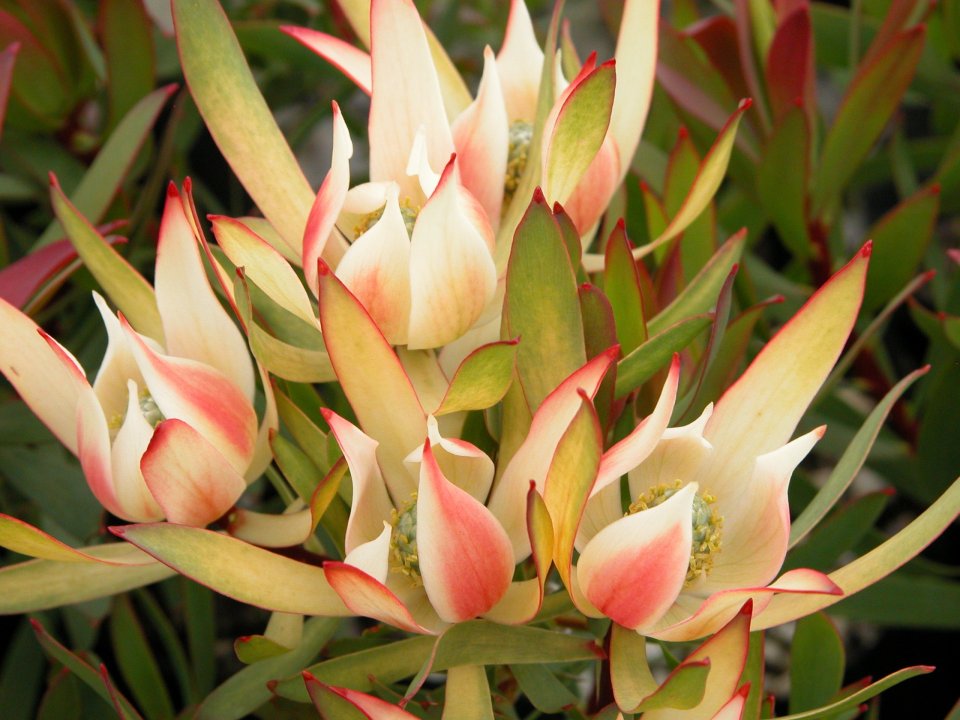
Leucadendron Cream Delight
 Notify Me
Leucadendron Cream Delight is a compact evergreen shrub grown for its ivory-white bracts, which develop a soft pink blush as they mature. The colourful bracts surround a central cone and hold their display for weeks, making this leucadendron a reliable choice for long-season garden interest. Plants reach around 0.8 to 1.2m high and wide, keeping them manageable in most garden settings.
This leucadendron suits a coastal garden, a low-water modern planting, or a dry sunny border. Use it in groups for a layered, textured effect, or as a stand-alone feature shrub. It pairs well with other proteas, grasses, and restios for a cohesive, water-wise bed.
Grow Leucadendron Cream Delight in full sun with free-draining, low-phosphorus, slightly acidic soil. Sandy or gravelly ground suits it well. Good airflow around the plant is important. Avoid rich, fertilised, or poorly drained soil, which stresses the roots.
This leucadendron is not suited to frost-prone inland areas such as Central Otago or inland Southland without shelter. Trim after the bract display fades to keep a tidy shape. Leucadendrons are not known to be toxic to cats, dogs, or horses, but discourage pets from chewing any garden plant as a general precaution.
Trimming: Trim after the bract display fades, typically in late summer to autumn. Cut back to healthy side shoots to keep the plant compact and bushy. Avoid cutting into old bare wood, as leucadendrons are slow to reshoot from it.
Deadheading: Deadheading is not essential. Removing spent bracts and cones tidies the plant, but leaving them does no harm and the cones add winter structure.
Fertilising: Do not use standard fertiliser. Leucadendrons are sensitive to phosphorus. If feeding at all, use a low-phosphorus native or protea-specific feed in spring, applied sparingly.
Watering: Water regularly through the first season to establish a strong root system, then reduce. Established plants are drought-tolerant and dislike sitting in constant moisture.
Pest Control: Leucadendrons are generally trouble-free. Check occasionally for scale and mealybugs on stressed plants and treat early with horticultural oil if needed.
Disease Management: Free-draining soil and good airflow are the main defences. Wet or heavy soil encourages Phytophthora root rot, which is the most common cause of decline in this family. Keep the root zone open and avoid overwatering.
Enjoy complimentary delivery anywhere in mainland New Zealand when you purchase plants worth $250 or more*.
For orders below $250, the following flat-rate delivery charges are applicable:
- Urban delivery within mainland New Zealand: $19.95
- Rural delivery within mainland New Zealand: $39.95
- Waiheke, Chatham and Great Barrier Islands: Please contact us for shipping options.
We aim to have all orders shipped within 14 days from the order date, unless a different shipping date is specified alongside a product.