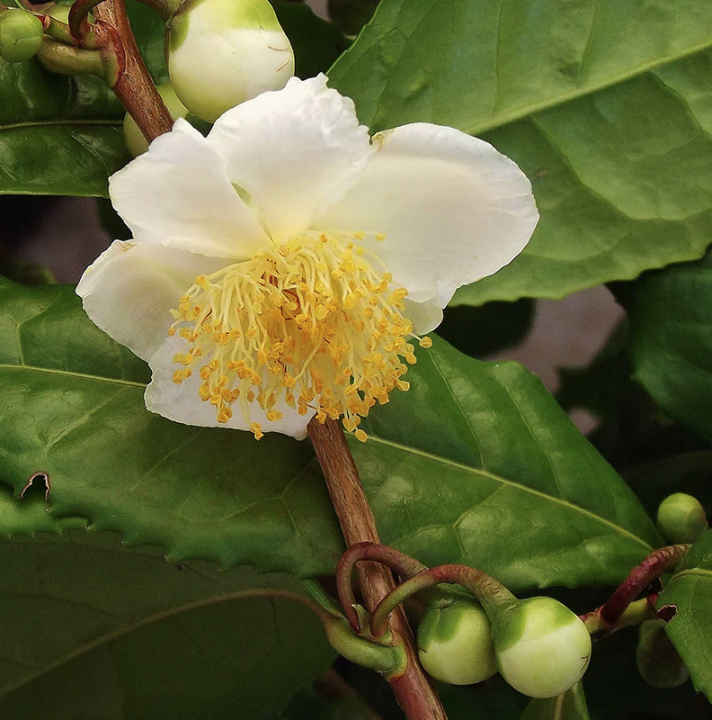
Camellia sinensis
Camellia sinensis is the tea plant, grown both as an ornamental shrub and as the source of true tea. Its small white flowers carry a soft yellow centre with a lemon blush, and they appear in autumn and winter when little else is in bloom. The plant develops into a tidy, dense shrub reaching around 1 to 3m high, depending on how often it is clipped.
This camellia suits a cottage garden, a productive kitchen garden, or a Japanese-style planting where its cultural history adds interest. Grow it as a specimen or plant in a row as a clipped hedge. The young leaves can be harvested and dried to make green or black tea, which gives it a use beyond its ornamental appeal.
Grow Camellia sinensis in part shade or morning sun with free-draining, acidic soil rich in organic matter. It dislikes waterlogged or alkaline ground. Work compost in at planting and mulch well to keep roots cool and moist.
Trim regularly if you want a compact shape or a formal hedge. Feed in spring with an azalea and camellia fertiliser. Camellia sinensis is generally considered non-toxic to cats and dogs, though the caffeine and tannins in the leaves can cause digestive upset if eaten in quantity, so discourage chewing.
Trimming: Trim after flowering in late winter or early spring to maintain shape. For a hedge, clip two or three times through the growing season. Camellia sinensis responds well to regular trimming and can be kept quite compact. Avoid hard pruning into old leafless wood.
Deadheading: Deadheading is not essential. You can remove spent flowers to tidy the plant and reduce the risk of petal blight, but leaving them does no harm.
Fertilising: Feed in spring with a fertiliser formulated for azaleas and camellias. A light second application after trimming supports new growth. Avoid high-phosphorus or general-purpose fertilisers, as the plant prefers acidic, low-nutrient conditions.
Watering: Keep the soil evenly moist through the first summer and during dry spells. Established plants are reasonably drought-tolerant but perform better with consistent moisture. Mulch helps retain water and keeps roots cool.
Pest Control: Watch for scale insects, aphids, and two-spotted mite, particularly during warm, dry periods. Check leaf undersides regularly and treat early with horticultural oil or a suitable spray.
Disease Management: Good drainage and airflow prevent most problems. Wet or heavy soil increases the risk of Phytophthora root rot. Camellia petal blight can affect the flowers in humid conditions; collect and bin fallen petals rather than composting them to reduce spread.
Enjoy complimentary delivery anywhere in mainland New Zealand when you purchase plants worth $250 or more*.
For orders below $250, the following flat-rate delivery charges are applicable:
- Urban delivery within mainland New Zealand: $19.95
- Rural delivery within mainland New Zealand: $39.95
- Waiheke, Chatham and Great Barrier Islands: Please contact us for shipping options.
We aim to have all orders shipped within 14 days from the order date, unless a different shipping date is specified alongside a product.