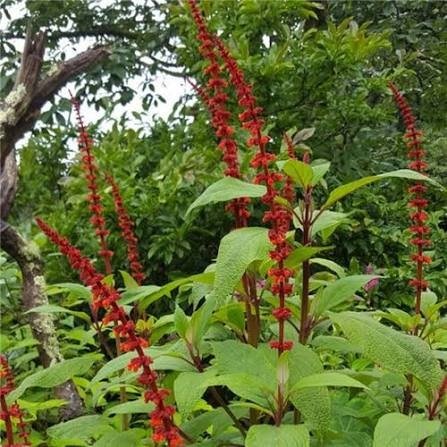
Salvia confertiflora
Red velvet sage is a big, deliberate plant and it looks like nothing else in a border. Salvia confertiflora sends up long slender spikes densely packed with small rust-red tubular flowers, and the calyces, stems and flower stalks are all covered in fine red-brown velvet, so the spike glows even before the flowers open. Coarse sage-scented leaves fill the lower plant. Flowering runs December to May.
This one belongs behind everything else, or standing alone where it has room to be seen. It suits subtropical-style planting, a warm sheltered courtyard, and any scheme built around hot colour and bold foliage. Bees and nectar-feeding birds work the spikes through the warmest months, and the flower stems cut well.
Plant in full sun in fertile, free-draining soil with shelter from strong wind. This is a tender salvia: the top growth is cut down by frost, so in most of the country it behaves as a herbaceous perennial that regrows from the base, while in frost-free coastal and northern gardens it builds into a woody shrub. Stake young plants until the stems firm up.
Reaches around 1.5 to 2 m tall and 1 to 1.5 m across in a good season.
Trimming: Cut the whole plant back to about 15 cm in late autumn where frosts are expected, which protects the crown and tidies the border. In frost-free gardens prune in early spring instead, taking out old woody stems to keep it producing fresh growth.
Deadheading: Remove spent spikes at the base through the season and more will follow. Left on, the old flower stems dull the effect of the new ones because the velvet fades to brown.
Fertilising: Feed as growth restarts in spring with a balanced slow-release fertiliser and mulch with compost. A plant putting up two metres in one season uses what it is given, so top it up again in December.
Watering: Water regularly through summer while it is building. Established plants cope with short dry spells but this is not a dry-garden salvia, and it wilts and drops lower leaves if left too long.
Pest Control: Aphids gather on soft new shoots in spring, and whitefly can build up under the leaves in a sheltered warm position. Slugs take the new growth as it comes through in spring.
Disease Management: Powdery mildew marks the foliage late in a humid season, particularly on crowded plants. Space it properly and water at ground level. Root rot follows heavy soil that stays wet in winter.
Enjoy complimentary delivery anywhere in mainland New Zealand when you purchase plants worth $250 or more*.
For orders below $250, the following flat-rate delivery charges are applicable:
- Urban delivery within mainland New Zealand: $19.95
- Rural delivery within mainland New Zealand: $39.95
- Waiheke, Chatham and Great Barrier Islands: Please contact us for shipping options.
We aim to have all orders shipped within 14 days from the order date, unless a different shipping date is specified alongside a product.