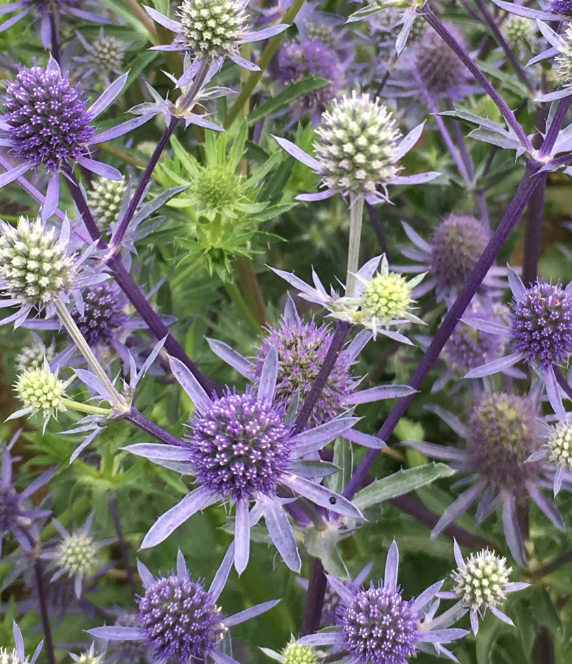
Eryngium Blue Glitter
Metallic is the right word for it. Eryngium planum 'Blue Glitter' produces small cone-shaped flower heads of steel blue, each ringed by a collar of narrow spiny bracts, on branching stems that turn the same silvery blue right down to the base. A mature plant carries dozens of heads at once. The basal leaves are dark green and rounded, quite unlike the flowers above them. Flowering is December to February.
Sea holly earns a place for texture as much as colour, and it stays looking sharp through the hottest part of summer when softer plants sag. Use it in gravel gardens, dry sunny borders, coastal plantings and contemporary schemes, alongside grasses, achillea and sedums. It is one of the best cut flowers of the season, holding colour fresh and drying almost unchanged.
Full sun and free-draining, low-fertility soil give the strongest colour and the stiffest stems. The plant grows from a deep taproot, so it dislikes being moved or divided and is best planted once and left. Poor stony ground and dry banks suit it. Space 40 cm apart. The bracts are genuinely prickly, so wear gloves when cutting a bunch.
Grows 0.5 to 1 m tall with a clump 0.3 to 0.5 m across.
Trimming: Leave the stems through autumn, as the dried heads hold their shape and colour for months. Cut them to the base in late winter. Avoid disturbing the crown or lifting the plant to divide it.
Deadheading: Not needed and not recommended, since the ageing heads are part of the appeal. Cut stems for the vase instead, taking them just before the cones fully open.
Fertilising: Do not feed. Sea holly grown in fertile soil produces tall soft stems that lean over and lose the metallic colouring that makes it worth growing.
Watering: Water only while establishing in the first season. The taproot finds its own moisture afterwards, and the plant is far more likely to be lost to winter wet than to summer drought.
Pest Control: Slugs and snails can damage new spring growth on young plants. Aphids occasionally appear on flower stems and rarely need treatment.
Disease Management: Root rot in heavy or waterlogged soil is the main risk. Powdery mildew and leaf spot can mark the basal leaves in humid weather, and improving airflow around the plant deals with it.
Enjoy complimentary delivery anywhere in mainland New Zealand when you purchase plants worth $250 or more*.
For orders below $250, the following flat-rate delivery charges are applicable:
- Urban delivery within mainland New Zealand: $19.95
- Rural delivery within mainland New Zealand: $39.95
- Waiheke, Chatham and Great Barrier Islands: Please contact us for shipping options.
We aim to have all orders shipped within 14 days from the order date, unless a different shipping date is specified alongside a product.