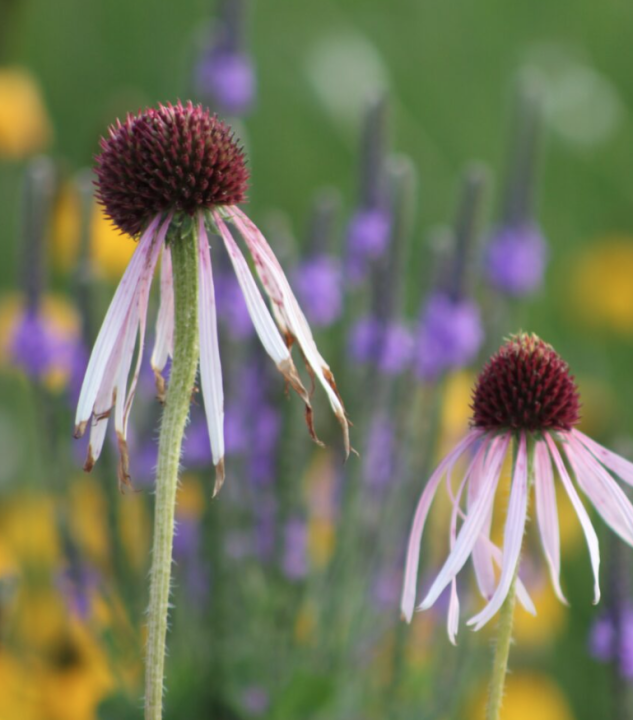
Echinacea pallida
Long, narrow petals that hang straight down give Echinacea pallida a shape quite unlike the flat-faced coneflowers most gardeners know. The rays are pale rose-pink, almost thread-thin, drooping from a raised orange-brown cone so the whole flower reads as a shuttlecock on a tall bare stem. Leaves are narrow, rough and mostly gathered near the base. Flowering is December to March.
This is a prairie plant and it looks right in prairie-style planting, threaded through grasses where the flowers can be seen from the side and lit from behind. It also works in a dry sunny border, in gravel gardens and in meadow schemes. Bees and butterflies feed on the cones, and the seed heads stand into winter for the birds.
Full sun and free-draining soil are essential. Pale coneflower has a deep taproot, which makes it more drought tolerant and longer lived than the garden hybrids, but also means it dislikes being moved once settled. Poor and stony ground suits it. Wet winter soil is what shortens its life, so add grit to clay or plant on a rise. Space 40 to 50 cm apart.
Reaches 1 to 1.5 m tall in flower with a clump 0.3 to 0.5 m across.
Trimming: Leave the stems standing over winter for the seed heads, then cut them to the ground in late winter before new growth appears. Avoid dividing or shifting established plants, as the taproot resents it.
Deadheading: Optional. Removing spent flowers may bring a few later stems, but the cones are a large part of the plant's autumn and winter value, so most gardeners leave them on.
Fertilising: Very little needed. A light general fertiliser in early spring is enough and rich soil produces tall soft stems that lean. Skip the compost mulch over the crown, which can encourage rot.
Watering: Water through the first summer to get the taproot down. After that it is properly drought tolerant and better left dry than watered often.
Pest Control: Slugs and snails take new spring shoots, which matters most on young plants. Aphids sometimes gather under the developing flower buds.
Disease Management: Crown and root rot in wet ground is the main risk and the reason most plants are lost. Powdery mildew can mark the lower leaves late in a humid season, and better spacing prevents it.
Enjoy complimentary delivery anywhere in mainland New Zealand when you purchase plants worth $250 or more*.
For orders below $250, the following flat-rate delivery charges are applicable:
- Urban delivery within mainland New Zealand: $19.95
- Rural delivery within mainland New Zealand: $39.95
- Waiheke, Chatham and Great Barrier Islands: Please contact us for shipping options.
We aim to have all orders shipped within 14 days from the order date, unless a different shipping date is specified alongside a product.