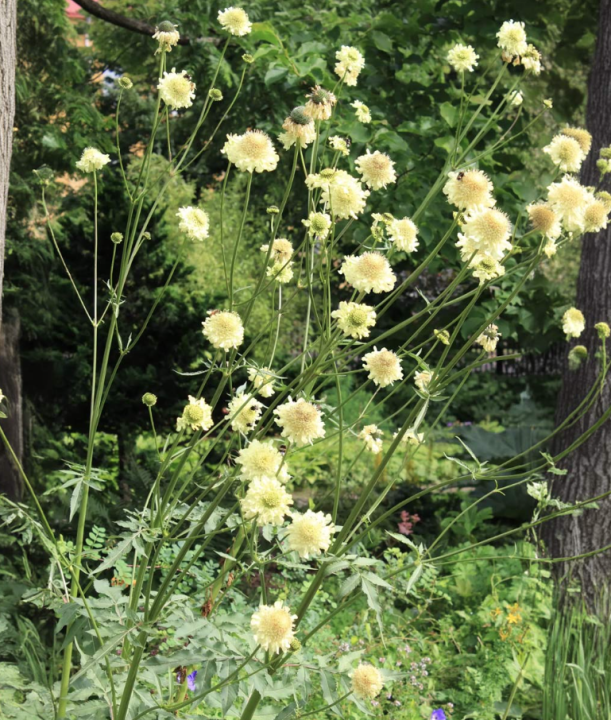
Cephalaria gigantea
Cephalaria gigantea sends slim branching stems far above its foliage and carries pale primrose-yellow scabious flowers on the ends of them. The giant scabious is a large plant that reads as a light one, because the stems are thin enough to see straight through and the flowers sit singly rather than in trusses. Flowering runs from December through February, and bees work it steadily.
Height without bulk is the reason to grow it. Put giant scabious at the back of a border, or part way forward where the flowers float above shorter planting and the stems disappear from view. It suits meadow-style and cottage schemes and holds its own among tall grasses. The flowers cut well, though the stems are long enough to need a tall vase.
Full sun to light shade, in free-draining soil that stays reasonably moist through summer. It grows well across most New Zealand districts. The basal clump of divided leaves stays low and tidy, so the plant occupies very little ground for its height. Stake in exposed or windy gardens. Work compost into thin soils before planting and space about 0.6 m apart.
Flower stems reach 1.5 to 2 m over a leaf clump 0.5 to 0.6 m high and roughly the same across.
Trimming: Cut the flowering stems right back to the basal clump once flowering ends in late summer, then cut the foliage to the ground in autumn as it dies down. Plants can be shortened by cutting back by a third in early November if a lower, bushier plant is wanted. Divide every four or five years in early spring.
Deadheading: Removing spent flowers as they brown keeps the plant flowering longer and stops it seeding around, which it will do freely in open ground. Leave a few heads at the end of the season if seedlings are wanted.
Fertilising: A single application of balanced slow-release fertiliser in early spring is enough. Cephalaria is not a hungry plant and over-feeding produces soft stems that need staking. A compost mulch in spring holds moisture through the summer flowering period.
Watering: Water well through the first summer while the deep root system develops. Established plants tolerate dry spells but produce more flowers with steady moisture from November onwards. Mulch to reduce watering through the hottest months.
Pest Control: Aphids gather on the soft upper stems in warm weather and are easily washed off. Slugs and snails take new spring growth at the base of the clump and are worth controlling as shoots emerge.
Disease Management: Powdery mildew can mark the lower leaves in a humid summer, particularly where plants are crowded. Space generously, keep the base clear of dense planting, and remove affected leaves. Root rot occurs only in soil that stays wet over winter.
Enjoy complimentary delivery anywhere in mainland New Zealand when you purchase plants worth $250 or more*.
For orders below $250, the following flat-rate delivery charges are applicable:
- Urban delivery within mainland New Zealand: $19.95
- Rural delivery within mainland New Zealand: $39.95
- Waiheke, Chatham and Great Barrier Islands: Please contact us for shipping options.
We aim to have all orders shipped within 14 days from the order date, unless a different shipping date is specified alongside a product.