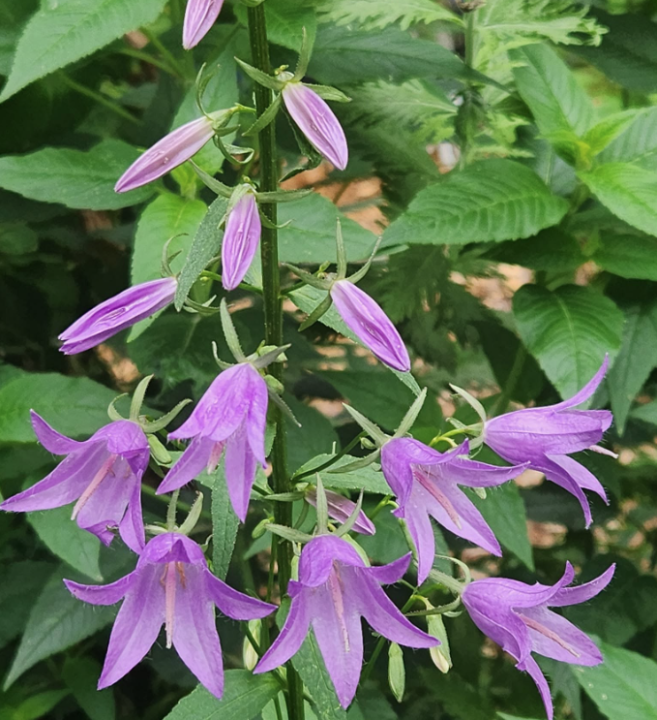
Campanula rapunculoides Violet
Campanula rapunculoides is the creeping bellflower, and its violet flowers hang in a one-sided row down tall straight stems from December into February. The bells are narrow and nodding, quite unlike the open cups of the peach-leaved kinds, and the heart-shaped basal leaves fade away as the flowering stems extend. It travels by deep white rhizomes and will move well beyond where it is planted.
That habit decides where this bellflower belongs. It will fill a rough bank, a wild corner, or a strip between a fence and a path where nothing else has held, and the stems are useful for cutting. Keep it out of a mixed border with slower perennials, and away from a boundary shared with a neighbour. A container is the safe way to grow it.
Almost any soil suits it, in sun or shade, and it has naturalised in parts of New Zealand, so it plainly needs no encouragement. Dry, poor ground slows it a little. The rhizomes snap readily and every fragment regrows, which makes digging it out slow work. Cut the stems down before seed sets to limit how far it goes.
Flowering stems reach 0.6 to 1 m, and a colony spreads indefinitely once it has settled in.
Trimming: Cut all flowering stems to the ground as soon as the last bells fade, well before seed ripens. Removing top growth does not slow the rhizomes but it does stop the plant seeding into other parts of the garden. Cut back again in autumn to tidy the clump.
Deadheading: Deadheading matters here for containment rather than appearance. Take spent flowers off as they finish so no seed is set, and never compost the stems once seed has formed.
Fertilising: No feeding is needed or wanted. Creeping bellflower grows strongly in poor soil, and fertiliser simply speeds up how fast it colonises. Skip the spring feed and skip the mulch, which only makes the rhizomes easier to run through.
Watering: Water only to establish new plants in their first few weeks. After that it finds its own moisture, and dry conditions are one of the few things that hold it in check. Container-grown plants need normal summer watering.
Pest Control: Few pests trouble this plant. Slugs and snails may graze new spring shoots but rarely cause lasting damage, and no routine control is needed.
Disease Management: Rust and powdery mildew occasionally mark the foliage in humid weather without affecting the plant's vigour. The practical management task with this species is containment, so check each spring for shoots appearing outside the intended area and dig them out while they are small.
Enjoy complimentary delivery anywhere in mainland New Zealand when you purchase plants worth $250 or more*.
For orders below $250, the following flat-rate delivery charges are applicable:
- Urban delivery within mainland New Zealand: $19.95
- Rural delivery within mainland New Zealand: $39.95
- Waiheke, Chatham and Great Barrier Islands: Please contact us for shipping options.
We aim to have all orders shipped within 14 days from the order date, unless a different shipping date is specified alongside a product.