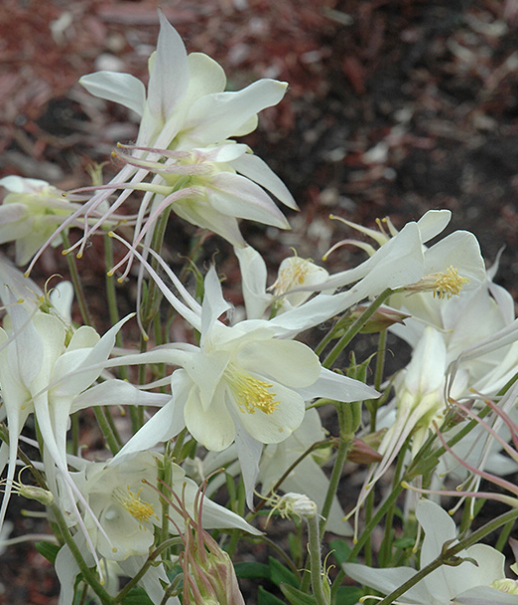
Aquilegia White Star
Pure white through the whole flower, spurs included, gives 'White Star' a clarity the bicoloured columbines do not have. The nodding flowers of this Aquilegia caerulea selection face outward on branching stems, each with five long backward-pointing spurs and a cluster of pale stamens at the centre. Soft blue-green leaflets make a low mound beneath. It flowers from October into December.
White columbine is one of the easiest ways to lighten a shaded border in spring. It belongs in cottage and woodland planting, in white and green schemes, and in a courtyard pot where the flowers can be seen close up. It sits well with hostas, ferns and hellebores, all of which are at their best at the same time of year.
Give it morning sun and afternoon shade, in free-draining ground that stays reasonably moist, allowing 30 to 40 cm between plants. Warmer, drier gardens should give it afternoon shade. Like all aquilegias it is short-lived and keeps itself going by seeding. Seedlings will not be white if other aquilegias are flowering nearby, so grow it on its own to keep the colour clean.
Reaches 0.6 to 0.75 m in flower, spreading to about 0.4 m.
Trimming: Once flowering finishes in midsummer, cut the flower stems out at the base. Shearing the leaf mound to the ground at the same time brings a tidy new flush of foliage that carries the plant through to autumn.
Deadheading: Take spent flowers off to keep new buds coming. Where you want the white form to persist, save seed from a plant growing well away from any coloured aquilegia, as bees cross them readily.
Fertilising: Mulch with compost in early spring and add a balanced slow-release fertiliser as new leaves appear. That single feed covers the whole season.
Watering: Even moisture from October to December gives the longest flowering season. Container plants dry out quickly and need checking every day or two in warm weather.
Pest Control: Look for the pale tunnels of aquilegia leaf miner on the leaves, which do no real damage. Aphids and sawfly larvae are the two worth acting on, and both can be dealt with by hand on a garden-sized clump.
Disease Management: Powdery mildew turns midsummer foliage grey, and cutting the plant back resolves it. Downy mildew is more serious and causes stunted, twisted growth, so lift and dispose of affected plants rather than treating them.
Enjoy complimentary delivery anywhere in mainland New Zealand when you purchase plants worth $250 or more*.
For orders below $250, the following flat-rate delivery charges are applicable:
- Urban delivery within mainland New Zealand: $19.95
- Rural delivery within mainland New Zealand: $39.95
- Waiheke, Chatham and Great Barrier Islands: Please contact us for shipping options.
We aim to have all orders shipped within 14 days from the order date, unless a different shipping date is specified alongside a product.