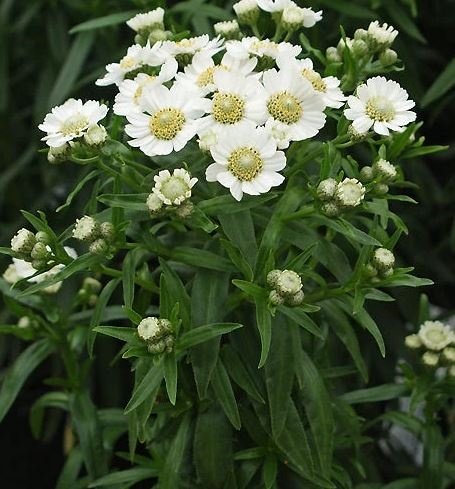
Achillea ptarmica uniflora
 Notify Me
Sneezewort looks nothing like the flat-headed yarrows. Achillea ptarmica carries loose sprays of small white flowers, every one a tight rosette of short petals around a pale centre, on slim upright stems. The leaves are narrow, toothed and plain green rather than ferny and grey. Flowering runs from December through to March, and the white reads clearly from a distance in a mixed border.
This is a good filler between stronger plants, and it suits cottage gardens, white and green planting schemes and damper corners where most yarrows sulk. The sprays are among the most useful cut flowers in the genus, fresh or dried, and florists use them the way gypsophila is used. Hoverflies and bees feed on the flowers steadily right through summer.
Sneezewort wants full sun to light shade and soil that stays moist, which sets it apart from the drought-tolerant yarrows. It grows happily in heavier ground and beside a pond. Be aware that it spreads by underground rhizomes and travels, so plant it where it can run, or sink a barrier around it, or lift and divide every second year to keep it in bounds.
Reaches around 0.4 to 0.6 m tall, spreading indefinitely at the root unless it is contained.
Trimming: Take the stems right down to soil level over winter. A hard shear straight after the first flush of flowers often brings a second, lighter one before the season ends. Gloves are sensible, as yarrow foliage causes a rash on sensitive skin.
Deadheading: Cut spent sprays out as they brown. This matters more with sneezewort than with other yarrows, because seed adds to a spreading habit that is already energetic.
Fertilising: Unlike its dry-ground relatives, this one appreciates a spring mulch of compost to hold moisture. A light general fertiliser at the same time is enough for the year.
Watering: Keep the soil damp. Sneezewort is the yarrow that suffers first in drought, wilting and browning at the leaf tips, so water through dry spells and mulch to reduce the need.
Pest Control: Aphids on soft new stems and slug damage on spring growth are the two to watch, both easily managed in a garden setting.
Disease Management: Powdery mildew is common where plants are crowded and dry at the root, an awkward combination that comes from planting too close. Thin congested clumps by division and keep the soil moisture steady.
Enjoy complimentary delivery anywhere in mainland New Zealand when you purchase plants worth $250 or more*.
For orders below $250, the following flat-rate delivery charges are applicable:
- Urban delivery within mainland New Zealand: $19.95
- Rural delivery within mainland New Zealand: $39.95
- Waiheke, Chatham and Great Barrier Islands: Please contact us for shipping options.
We aim to have all orders shipped within 14 days from the order date, unless a different shipping date is specified alongside a product.