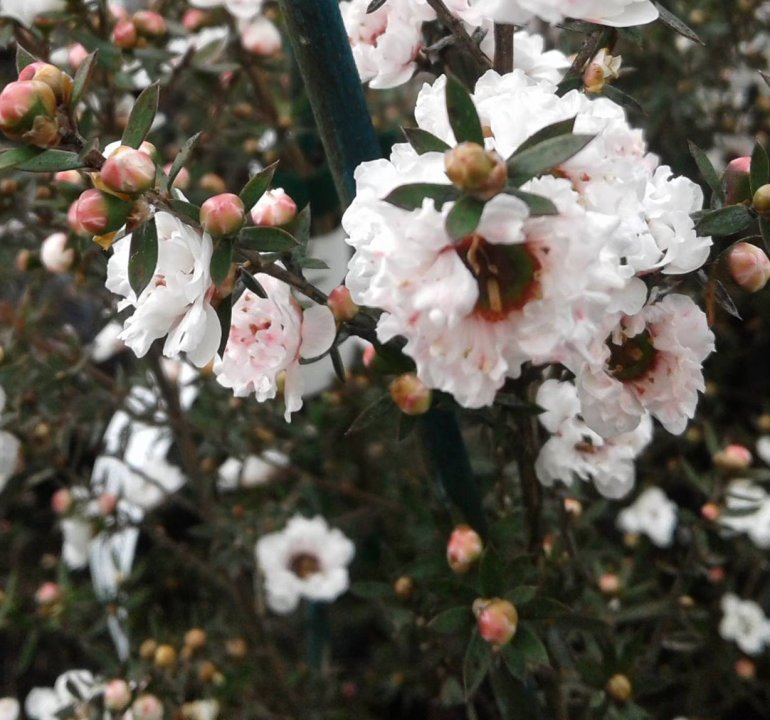
Leptospermum Princess Anne
 Notify Me
Leptospermum Princess Anne is a charming evergreen shrub known for its profusion of double white flowers with dark-red centres, which appear through spring and early summer. The small, fine foliage creates a dense backdrop that gives the plant year-round texture and helps highlight its delicate flowering display.
Its compact, bushy habit makes it a versatile choice for borders, mixed shrub plantings, cottage gardens, and coastal sites. It is also well suited to low hedging, feature planting, and smaller garden spaces where reliable colour and structure are wanted.
For best growth, plant in full sun in well-drained soil. It will tolerate dry conditions once established and performs well in exposed positions. Space plants around 1-1.5m apart to allow them to develop a full, healthy form.
At maturity, it forms a neat, rounded shrub approximately 1.5-2m tall and 1.5-2m wide.
Trimming: Leptospermum Princess Anne is naturally bushy and compact, so it usually only needs light trimming. Tidy it after flowering or in early spring to keep a dense shape, removing any dead, damaged or straggly growth. Avoid hard pruning into old wood.
Deadheading: Deadheading is not essential, but you can lightly remove spent flowers to keep the plant looking neat through the flowering season.
Fertilising: Apply a light slow-release fertiliser in spring if growth is weak or the soil is poor. Avoid heavy feeding, as mānuka generally performs best without excessive fertiliser.
Watering: Water regularly during the establishment phase so the roots settle in well. Once established, Leptospermum Princess Anne is reasonably drought tolerant, but it will benefit from occasional deep watering during extended dry periods. Free-draining soil is important.
Pest control: Check for scale insects, caterpillars and spider mites, especially in warm or dry conditions. Watch for sticky residue, chewed foliage, fine webbing or leaf discolouration, and treat early with insecticidal soap, a suitable garden spray, or by pruning out badly affected growth. These pest notes are based on common issues for mānuka and related shrubs rather than cultivar-specific reports.
Disease management: The main risk is root stress or root rot in poorly drained soil. Look for yellowing, thinning growth, dieback or poor vigour. Improve drainage, avoid overwatering, and remove affected stems if dieback develops. Good airflow around the plant will also help reduce disease problems.
Enjoy complimentary delivery anywhere in mainland New Zealand when you purchase plants worth $250 or more*.
For orders below $250, the following flat-rate delivery charges are applicable:
- Urban delivery within mainland New Zealand: $19.95
- Rural delivery within mainland New Zealand: $39.95
- Waiheke, Chatham and Great Barrier Islands: Please contact us for shipping options.
We aim to have all orders shipped within 14 days from the order date, unless a different shipping date is specified alongside a product.