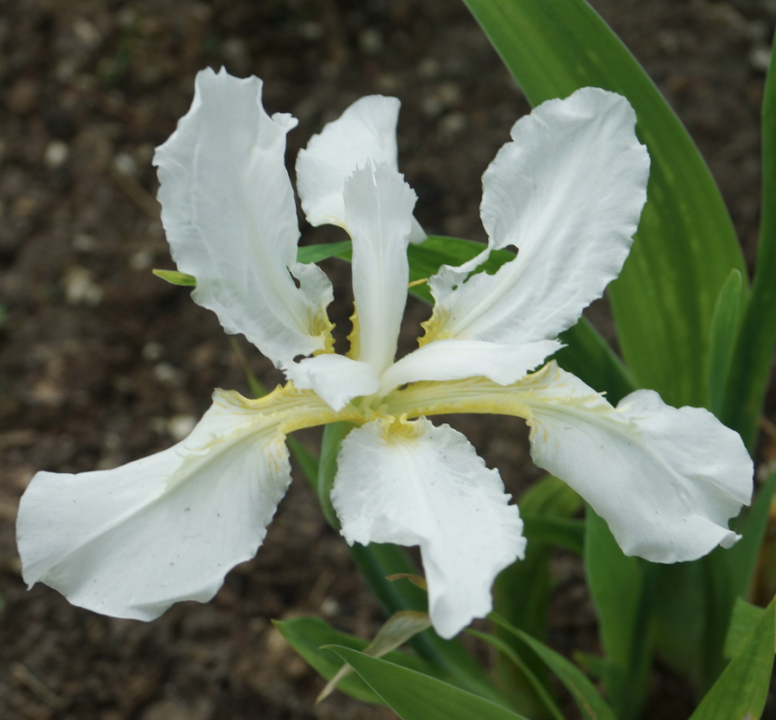
Iris tectorum Album
The white form of the Japanese roof iris, Iris tectorum 'Album' or 'Alba' carries pure white flowers with a yellow-tipped crest and none of the lilac veining seen on the straight species. Petals are broad and held almost flat, so each flower reads as a disc rather than a spire, and they open across November and December above fans of ribbed light green foliage.
White flowers hold up in shade better than blue ones do, so this form is worth using along a shaded path edge, under the light canopy of a deciduous tree, or in a courtyard where walls take the sun off part of the day. It combines with hostas, ferns and black mondo grass.
Give it a position in full sun to light shade with sharp drainage. As with the species, the rhizomes creep along the soil surface and must not be buried or covered with mulch. Winter wet is the main risk, so avoid low ground and heavy clay unless the bed is lifted and grit worked through. Grows well throughout New Zealand. Split congested clumps at the end of summer, every third or fourth season.
Flower stems reach 0.4 m over leaf fans about 0.3 m high, with the clump broadening to roughly 0.5 m over time.
Trimming: Take flowering stems out at the base once the last flower has gone. Tidy browned leaf tips by trimming to green, keeping the natural fan outline. Reduce foliage to about 15 cm at division time in February or March, which reduces wind rock while the replanted rhizome settles.
Deadheading: Pick off each spent flower as it collapses, since white petals go translucent and mark the buds beneath. Cut the stem out entirely once all buds have finished so no seed pods form.
Fertilising: Feed sparingly in early spring with a low-nitrogen product scattered over the surrounding soil, keeping granules off the bare rhizome. Follow with a second light feed once flowering ends. Rich nitrogen feeding is the most common cause of soft growth and rot in surface-rooted irises.
Watering: Keep moisture up through spring as the flower stems form, then let the bed dry out through summer. The white form is no more thirsty than the species, and the summer bake on the rhizomes is part of what produces flowers the following year.
Pest Control: Snails and slugs are the main nuisance, chewing emerging buds in spring, and are worth controlling from late winter. Aphids occasionally cluster on flower stems and are dislodged with water.
Disease Management: Soft brown rot at the rhizome follows waterlogging or burial, and is dealt with by cutting the affected tissue away cleanly and letting the surface dry in the sun. Fungal leaf spotting in humid weather is cosmetic. Remove marked leaves and improve airflow around the clump.
Enjoy complimentary delivery anywhere in mainland New Zealand when you purchase plants worth $250 or more*.
For orders below $250, the following flat-rate delivery charges are applicable:
- Urban delivery within mainland New Zealand: $19.95
- Rural delivery within mainland New Zealand: $39.95
- Waiheke, Chatham and Great Barrier Islands: Please contact us for shipping options.
We aim to have all orders shipped within 14 days from the order date, unless a different shipping date is specified alongside a product.