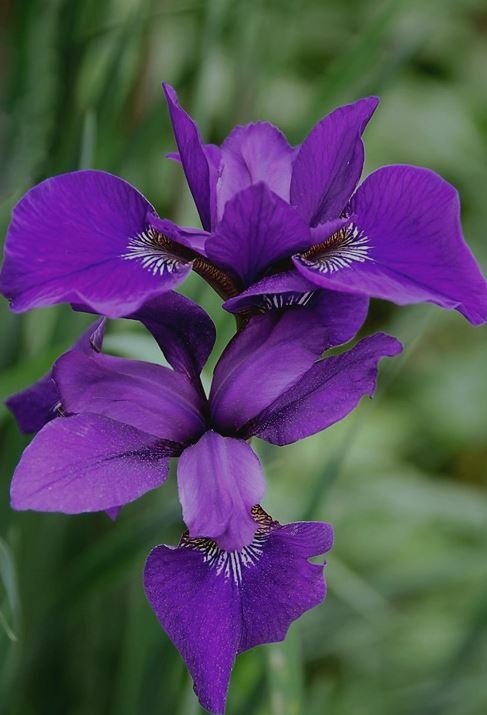
Iris s. Ceasars Brother Royal
 Notify Me
If one Siberian iris sets the standard, it is this one. 'Caesar's Brother' has been grown for close to a century for its dark velvety violet-purple flowers, held three or four to a stem well clear of the leaves, the falls faintly veined and marked with a small pale signal. Narrow upright grassy foliage stays neat all season. Flowering peaks in November.
Siberian iris are the easiest of the family and this one carries a border reliably year after year. Use it in a mixed perennial planting, in a group beside water, along a driveway, or as a mass of vertical foliage among mounding plants. The dark flowers cut well, and the seed pods that follow are worth keeping for arrangements.
Plant in full sun to light shade in soil that holds moisture through summer. Unlike the Japanese iris it tolerates a spell of dryness once established, and unlike the bearded iris it does not want a summer bake. Set the rhizome just below the surface, space plants 45 cm apart, and mulch to keep the roots cool. Divide after flowering in late summer.
Forms a clump around 0.9 m tall in flower and 0.6 m across.
Trimming: Clear the flower stems after flowering, or leave a few to form seed pods. Take the foliage down to about 15 cm when it turns straw-coloured in late autumn. Divide clumps in late summer when the centre thins.
Deadheading: Optional on Siberians. Spent flowers shrivel neatly rather than collapsing into a mess, so removal is about tidiness rather than necessity.
Fertilising: Scatter general fertiliser around the clump as growth starts in spring, then mulch with compost. Siberian iris are not heavy feeders and one application a year is enough.
Watering: Keep the soil moist while the buds form in spring. Established clumps tolerate short dry spells, though flowering is heavier where moisture is steady.
Pest Control: Very little troubles a Siberian iris. The exception is slug and snail damage on new spring growth, which is worse where old foliage has been left lying as shelter.
Disease Management: Rust and leaf spot show up occasionally in humid weather as spotted or streaked leaves. Cut affected foliage out and clear all dead leaves each autumn, which breaks the cycle.
Enjoy complimentary delivery anywhere in mainland New Zealand when you purchase plants worth $250 or more*.
For orders below $250, the following flat-rate delivery charges are applicable:
- Urban delivery within mainland New Zealand: $19.95
- Rural delivery within mainland New Zealand: $39.95
- Waiheke, Chatham and Great Barrier Islands: Please contact us for shipping options.
We aim to have all orders shipped within 14 days from the order date, unless a different shipping date is specified alongside a product.