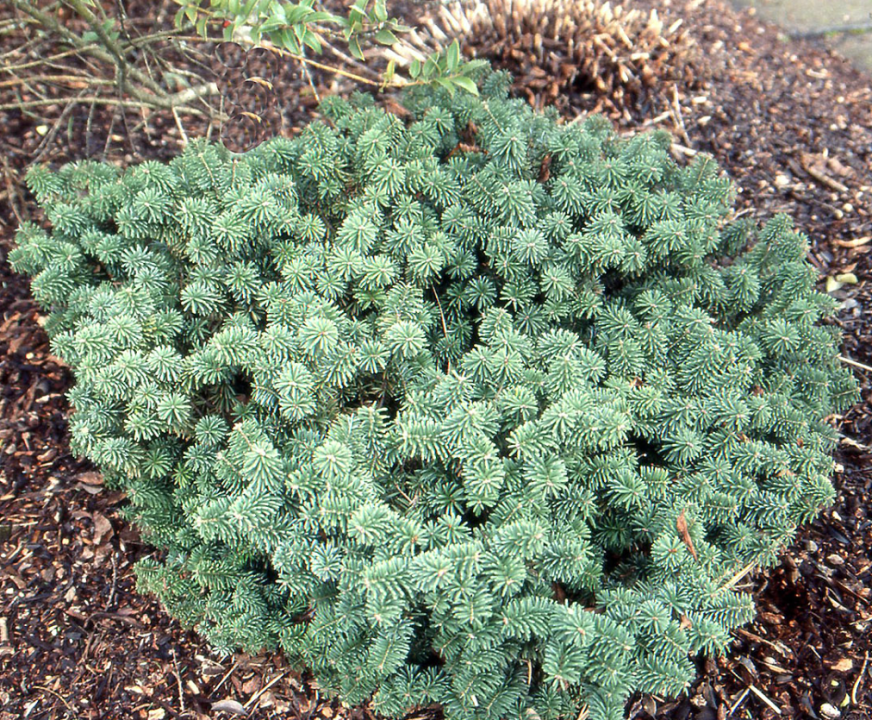
Abies balsamea hudsonia Nana
 Notify Me
Short, soft needles packed tightly along every shoot give Abies balsamea (Hudsonia Group) 'Nana' the look of a solid green cushion. This dwarf balsam fir grows as a low rounded mound rather than a tree, its deep green needles marked with two pale silver bands underneath. Spring growth comes through a lighter green, and brushed foliage releases the resinous balsam scent the species is named for.
Slow growth makes this dwarf conifer easy to place. It suits rock gardens, gravel beds and the front edge of a mixed border, and holds its shape beside a path where a full-sized conifer would soon outgrow the space. It gives permanent structure among perennials, and sits happily in a large pot on a courtyard for years.
Balsam fir is a cool-climate conifer. Plant in full sun to light shade in free-draining soil that stays cool and slightly moist through summer, and mulch to keep the root zone from baking. It does best in cooler districts and higher country, and is not recommended for warm humid gardens in Northland and Auckland. On thin new-build soils, dig in compost first.
Expect around 0.5 to 1 m tall and up to 1.5 m across over many years, making it one of the smallest conifers we grow.
Trimming: No routine pruning is needed and the natural mound shape is the point of the plant. Cut out any dead or damaged shoots in late winter, and remove the occasional stronger stem that breaks the outline as soon as you see it. Never cut back into bare old wood, because fir does not reshoot from it.
Fertilising: Apply a slow-release conifer or acid-loving plant fertiliser in early spring as growth begins. One feed a year is enough. Top up the mulch at the same time, keeping it clear of the trunk.
Watering: Water regularly through the first two summers while the roots establish. Once settled it still resents drying out completely, so water deeply in long dry spells rather than lightly and often. Container plants need checking through summer.
Pest Control: Adelgids and spider mites are the pests to watch for, both more likely on plants stressed by heat or drought. Look for white woolly specks on the shoots or fine mottling on the needles, and treat with horticultural oil.
Disease Management: Root rot in wet ground is the main risk, so drainage matters more than feeding. Avoid planting in hollows that stay wet in winter. Needle cast can cause browning in humid conditions and is reduced by giving the plant open air movement.
Enjoy complimentary delivery anywhere in mainland New Zealand when you purchase plants worth $250 or more*.
For orders below $250, the following flat-rate delivery charges are applicable:
- Urban delivery within mainland New Zealand: $19.95
- Rural delivery within mainland New Zealand: $39.95
- Waiheke, Chatham and Great Barrier Islands: Please contact us for shipping options.
We aim to have all orders shipped within 14 days from the order date, unless a different shipping date is specified alongside a product.